Scott Snibbe recently visited IUPUI and gave a lecture concerning his artwork. Born in New York, Scott Snibbe has studied both fine art as well as computer science. This background has contributed to his unique take on art, and enabled him to create some of the most "interactively-addictive" pieces in the world. While Snibbe presented several of his works during the lecture, I intend to share only the two I favored most.
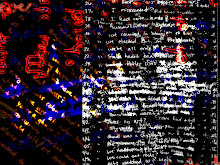
On display at Beall Center for Art and Technology in Irvine, California is Scott Snibbe's interactive piece known as Concentration. Imagine a giant shadow puppet theater. Now instead of only using your hands, you are able to project your entire body onto the wall. Not only this, but if you were the first person "on screen" you possess a glowing aura. Other people on the screen will also glow while you touch them, and if they "dig" deep inside of you they get to have the "power" of the aura instead. (This is accomplished by reaching your "shadow hands" into the "shadow heart" of the other person.) What I loved about this piece was its beauty and symbolism. The stunning aura toyed with my mind as I instantly gave it attributes it couldn't possibly posses. Most rudimentarily I attributed it power. This may have come from the fact that only one person could "possess" the aura. I also gave it a sense of worth which may have resulted from the videos of people trying to "steal" the aura. The list could go on, but more importantly, the symbolism I sensed (or made up) grabbed at my own heart. What if the aura was knowledge, or what if it was an emotion? Don't we pass those unseen "auras" on to others in real life? Whether it is from our mind or our heart, we transfer our own aura again and again, by using methods of speech, signs, and yes, even a touch on the shoulder.
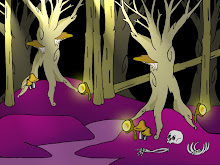
The other piece I enjoyed immensely is housed in Artspace New Haven in New Haven, Connecticut. The work is called Make Like a Tree. Again there is a huge screen that functions based on projected shadows. However, the screen contains elements of its own and records a certain number of past actions that are continuously being replayed. There is a series of trees always on screen. When a person walks across the screen, the action is saved and replayed between the first set of trees. When the second person walks by, the newly saved action is played in between the first set of trees and the first action is pushed back to the second set of trees. This continues for about five or six frames. What I loved was the idea of several different moments being seen at once as one overall moment (or movement). I can't help but say, I love things that inspire me! What if a pair of newlyweds wanted a work of art to celebrate their love? How beautiful would it be to change the basic scenery to ornate pillars with flowers or Arab tapestries in a sensual red color, and then have silhouettes of the couple dancing and kissing, etc. - all playing at once for just a moment...who wouldn't jump at the thought?!
In the end, I enjoyed Scott Snibbe's presentation and artwork. He inspired me, as I hope I have inspired you.
Wednesday, October 31, 2007


Friday, September 21, 2007
Blog Assignment #1 - My Topic of Choice
The Machine Stops
Imagine the world 100 years from now. What do you think life will be like? Would you believe me if I told you a man born almost 100 years before you could have a better idea of the future? It sounds absurd, but you haven't met E. M. Forster. Forster wrote a short fictional account in 1909 entitled "The Machine Stops." (click here for a link) In his story he addresses his view of the future through a relationship between a mother and her son. Here are a my thoughts:
I couldn't help thinking of the phrase "history repeats itself." The whole time my mind was fixated on creating links between the story's events and true historical accounts. This was not only with specific events but with general emotions and relative beliefs as well. While Vashti (the mother) seemed very cold she still couldn't completely shake the natural love she had for her son. While mankind itself was given everything it needed, rumors of waring against and punishing those who are deviant still existed. And above all, while fictionally today's religions did not exist, humans still couldn't shake the worship of a higher power. I sense that Forster recognized a unique key in life. While eras may seem so distinct, there have always existed basic truths that are in essence...plainly put...the truth. Kuno (the son) believed in freedom. It drove him near death, but he was persistent in what he felt was meaningful. That being said, the "truths" in life may not all be good. The machine itself concealed its errors until it was too late. The machine was deceitful and imperfect. My point is, though, that "learning from history" is not just deciding NOT to bomb a country or to start a war, but to actually look at history as a whole and draw deeper ideas and truths from it.
Imagine the world 100 years from now. What do you think life will be like? Would you believe me if I told you a man born almost 100 years before you could have a better idea of the future? It sounds absurd, but you haven't met E. M. Forster. Forster wrote a short fictional account in 1909 entitled "The Machine Stops." (click here for a link) In his story he addresses his view of the future through a relationship between a mother and her son. Here are a my thoughts:
I couldn't help thinking of the phrase "history repeats itself." The whole time my mind was fixated on creating links between the story's events and true historical accounts. This was not only with specific events but with general emotions and relative beliefs as well. While Vashti (the mother) seemed very cold she still couldn't completely shake the natural love she had for her son. While mankind itself was given everything it needed, rumors of waring against and punishing those who are deviant still existed. And above all, while fictionally today's religions did not exist, humans still couldn't shake the worship of a higher power. I sense that Forster recognized a unique key in life. While eras may seem so distinct, there have always existed basic truths that are in essence...plainly put...the truth. Kuno (the son) believed in freedom. It drove him near death, but he was persistent in what he felt was meaningful. That being said, the "truths" in life may not all be good. The machine itself concealed its errors until it was too late. The machine was deceitful and imperfect. My point is, though, that "learning from history" is not just deciding NOT to bomb a country or to start a war, but to actually look at history as a whole and draw deeper ideas and truths from it.
Monday, August 27, 2007
Issues
Okay, this is the second blog I've made...the first one no longer exists...it's weird, but that's life. So, let me say this again. To all my friends out there this blog is for school only right now, so please, as funny as it might be, don't spam this thing for giggles. Later Days All!
-Stephanie
-Stephanie
Subscribe to:
Posts (Atom)